
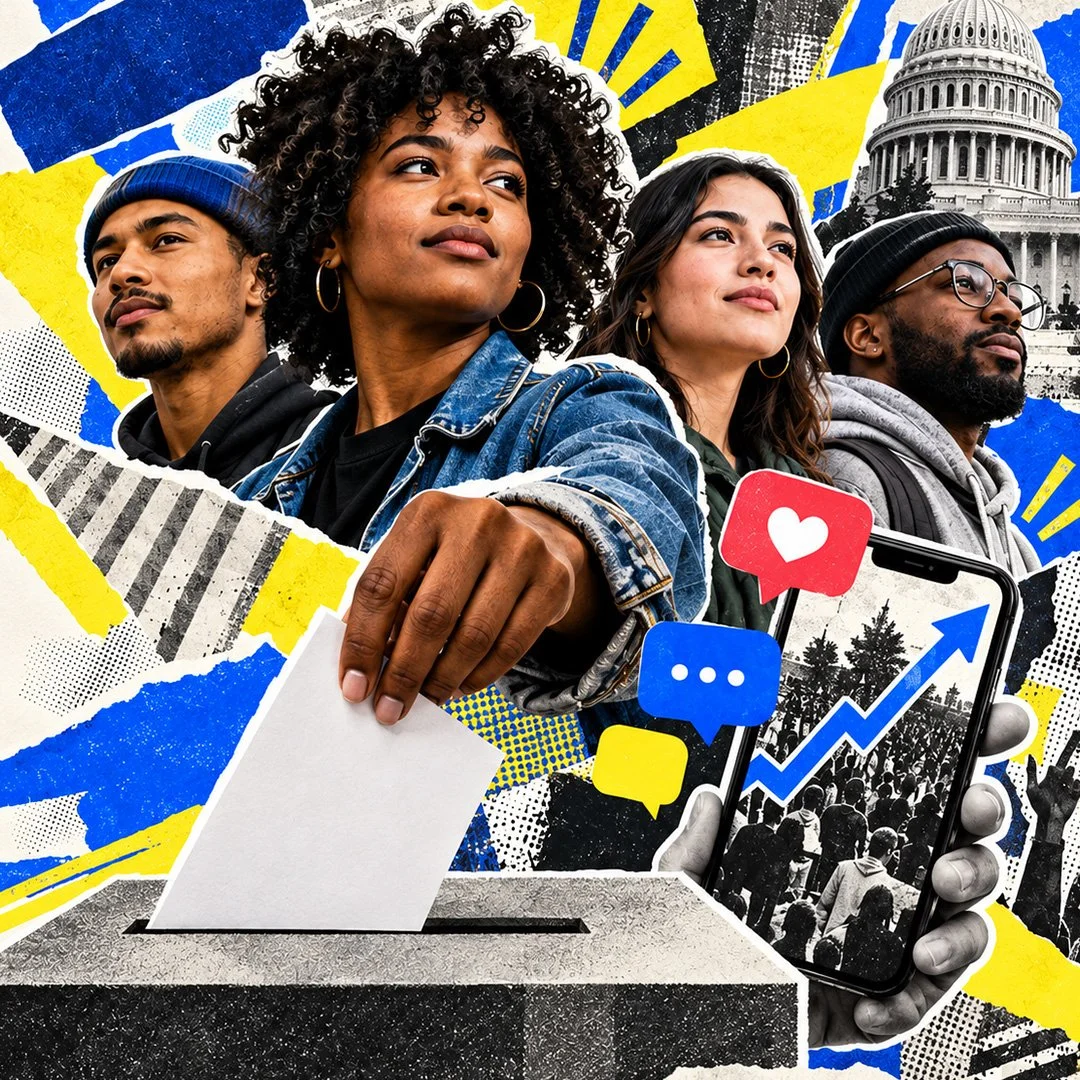
Plenty of young voters have been conditioned to think only presidential elections matter. But midterms are where local and congressional power actually live. Local and congressional officials make direct decisions on housing policy, funding for community safety, economic relief, and justice reform. Yet the fall 2026 Harvard Youth Poll, released less than two weeks before Election Day, found that only 34% of young Americans trust the midterms will be conducted fairly and accurately, while 40% have little or no trust. Just 33% say they will definitely vote, down from 40% ahead of both the 2018 and 2022 midterms. That skepticism is real. But skipping the ballot doesn’t make the system any fairer. Sitting out of the midterms leaves those decisions to whoever does show up. Silence doesn’t send a message, it hands over the mic. Voting puts young people’s collective power to work, so decisions about their daily lives aren’t made without them in mind.
Political conversations can feel exhausting for young adults, especially when the “adulting” has only just begun. In the spring 2026 Harvard Youth Poll, only about one in four young Americans approve of either party’s performance in Congress: 26% approve of congressional Democrats, while 25% approve of congressional Republicans. Beneath that low approval lies a growing frustration with the political system. The same poll found that nearly 57% of young Americans said the Republican Party cared more about elites, compared with 15% who said it cared more about people like them. For the Democratic Party, 37% said it cared more about elites, while 26% said it cared more about people like them.
For Elijah Nelson, a 22-year-old active voter who serves as president of Grambling State University’s NAACP chapter, the frustration lives deep within. “It is hard to stay motivated to vote and make my voice heard when I sometimes feel that the color of my skin and the generation I belong to influence how seriously my concerns are taken,” he said. “It can feel like the issues that matter to people like me are overlooked, even though we are the ones who will have to live with the consequences of the decisions being made today.”
“That is why midterm elections matter,” he added. “Even when the political system feels disconnected from us, our participation is a way to make sure our voices are not left out of the conversation.”
For Fumnanya Sartin, an educator and doctoral student in educational leadership at Xavier University of Louisiana, participation also depends on whether young people believe their involvement can lead to something.
“Education plays a critical role in developing civic awareness and helping young people understand how political decisions affect their communities,” she said.
She sees trust in leadership and access to information as important influences on engagement. “When young people feel heard, respected, and included in decision-making processes, they may be more motivated to become civically engaged.”
The spring 2026 Harvard Youth Poll found that 50% of young Americans say inflation affects them “a lot,” while 41% say the same about rising housing prices. By fall, cost of living had become the top issue: 91% of registered young voters with at least an even chance of voting called it important to their decision. For Sartin, concerns about affordability are closely connected to educational opportunity.
“As an educator, I recognize that educational inequities often intersect with broader socioeconomic challenges,” she said. “Young people want to know how policies will influence their ability to pursue higher education, establish careers, achieve financial independence, and build sustainable futures.”
Her perspective connects the cost-of-living discussion to what comes after graduation: whether students can afford to pursue the opportunities they have spent years preparing for.
At Grambling State University, engagement is already happening beyond the ballot box. De’Asia Mitchell, vice president of Grambling’s NAACP chapter and president of the Louisiana NAACP Youth and College Division, is one example of a young person turning civic interest into action. Through the chapter’s social media outreach, students are reminded when elections are approaching and given information on how to register, when and where to vote, and how to participate. For students who may not know where to start, that kind of digital outreach can turn a post on their timeline into a first step toward becoming an informed voter.
Mitchell believes involvement matters because young people are directly connected to the decisions being made around them.
"It is important for this generation to vote in midterm elections because our future is being shaped by the decisions made today. Voting gives our generation the opportunity to use our voices to influence issues that directly affect us, including education, healthcare, our rights, and the opportunities available to us. Our generation has the power to create the change we want to see, and exercising our right to vote is one of the most important ways we can help shape the future.”
That’s why midterms matter and why political education matters even more. When candidates come looking for young support this midterm season, they have to be held accountable for real action. While young voters say the ideal age for a representative is 39, only 5% say a candidate being under 40 is the main factor in their vote. What matters way more is real alignment: young voters prioritize candidates who genuinely share their values and want representatives who are independent of special interests. The 2026 midterm election is our opportunity to demand leaders who respect our safety, address our economic realities, and actually stand up for our communities. So let’s trend the midterms.